
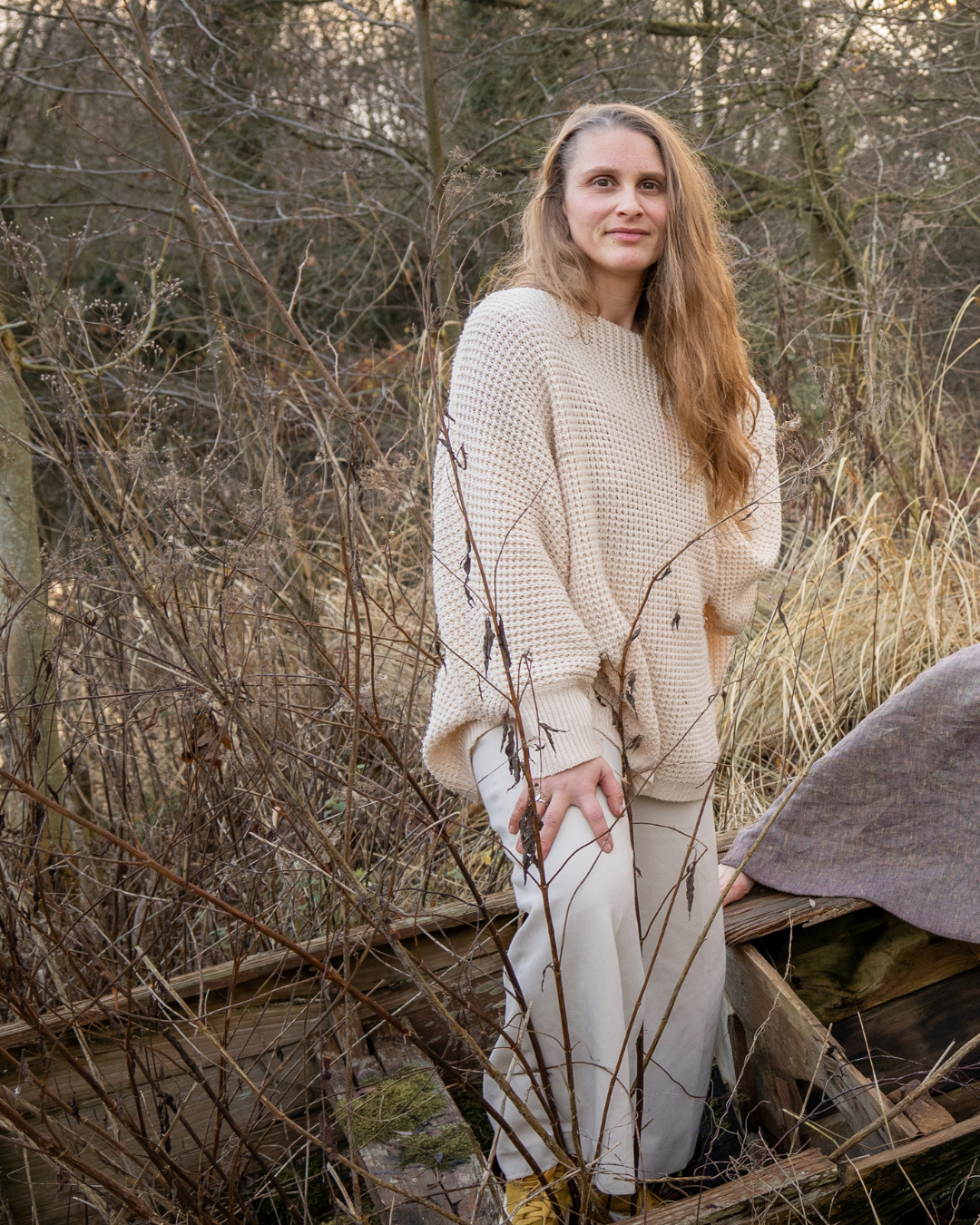
Janna Anand Jasjot
Janna Anand Jasjot is an artist, artistic explorer and guide whose work moves between art, intuition, ritual, nature and architecture.
At the heart of her practice is an exploration of what connects our inner and outer worlds — the visible and the unseen, intuition and structure, the feminine and the masculine, matter and energy.
With a background in Fine Arts and Interior Architecture, she explores how space, land and creative practice can become ways of seeing, listening and transformation.
Through art, journeys, gatherings and encounters, she follows what wants to become visible, creating spaces for remembering, trusting and creating from who we truly are.
-
From an early age, I found myself living between different worlds.
Between home and the outside world.
Between what was expected of me and what I deeply felt.
Between intuition and logic, the feminine and the masculine.I grew up in an environment where the outside world was often seen as something to fear, and where there was little room for an individual voice or inner truth.
Still, there was always another way of knowing within me — something I could feel, but couldn't yet fully understand or explain.
That tension stayed with me.
It followed me through my studies in Fine Arts and Interior Architecture, into my studio, and into my search for a way to bring these seemingly separate worlds together.
But the real turning point came through the heart.
An encounter, followed by a profound heartbreak, broke something open in me. What initially felt like losing myself became the beginning of a much deeper remembering.
It brought me into contact with parts of myself I had learned to silence. My intuition became stronger. Questions I had carried for years began to return in another form. And creativity became less about making something and more about listening to what was moving beneath the surface.
I began to understand that perhaps I didn't need to choose between the worlds I had always experienced as opposites.
The space between them had become my work.
What followed was not a straight path.
Rituals, meditation, Kundalini Yoga, retreats, circles, encounters with different people and cultures, and a deeper relationship with nature became ways of exploring and integrating what had opened.
Not as answers to follow, but as different ways of remembering, perceiving and listening.
Again and again, I was brought back to the same questions:
What happens when we stop trying to control or fix?
What becomes visible when we truly listen?
And what wants to be created from there?Over time, I began to see that what I had been searching for was not another system or something outside of myself.
It was a way back into relationship with what was already there.
And creation became the way I learned to listen.
-
I have come to see creativity not simply as the act of making something, but as a way of exploring.
I don't necessarily create to express something I already know.
I create to discover what I don't know yet.
Sometimes that exploration begins with material, colour or an image. Sometimes with a place, a question, a conversation, a historical trace or something I intuitively feel drawn towards.
I walk. I travel. I observe. I listen. I make connections.
My background in Fine Arts and Interior Architecture continues to shape the way I look at the world — how we move through spaces, how places and landscapes carry stories and memory, and how our inner world relates to the structures around us and the land beneath our feet.
I am drawn to the places where different worlds meet: art and spirituality, intuition and history, inner experience and physical landscape, structure and surrender.
Rather than separating these worlds, I explore what can emerge between them.
This is what being an Artistic Explorer means to me.
Not knowing exactly where something will lead, but being willing to follow it.
My studio is therefore not always a room.
It can be a landscape, a journey, a sacred place, a conversation or an encounter.
Nature is not simply a setting for my work. It is part of the exploration — something to enter into relationship with, to listen to and to create with.
Sometimes the exploration becomes an artwork.
Sometimes a journey.
A ritual.
A gathering.
A conversation.The form is not always known beforehand.
Listening comes first.
-
Out of this way of exploring grew what I call Artistic Alchemy.
Not as a fixed method or system, but as an ongoing practice of remembering, trusting and creating.
For me, alchemy is about transformation — allowing what has become fixed to move again, what has remained hidden to become visible, and what is beginning to emerge to take form.
But transformation does not necessarily mean becoming someone new.
Often, it is a process of remembering.
Remembering what was already there before we learned to doubt it.
Remembering our own way of knowing.
Remembering our relationship with the body, creativity, nature and the world around us.Art becomes a way of entering that process.
Not to find the right answer or to make something up, but to listen beneath what we think we know.
To give form to something before we can fully explain it.
To make the invisible visible.
And sometimes, through creating, to recognise something we somehow already knew.
-
My own exploration gradually changed the way I work with others.
I don't see my role as having the answers or showing someone which path to follow.
As a guide, I create spaces in which people can slow down, listen and explore what is already present within them.
Through gatherings, artistic practices, journeys, ritual and conversation, I bring together creativity, intuition, nature and place as different ways of entering that exploration.
There is no predetermined outcome.
We begin with what is there.
A question.
A feeling.
An image.
A place.
Something that wants our attention.From there, we listen, create and allow the process itself to show us where to go.
My role is not to tell someone which direction to take, but to create the conditions in which they can hear their own direction more clearly.
Remembering · Trusting · Creating